
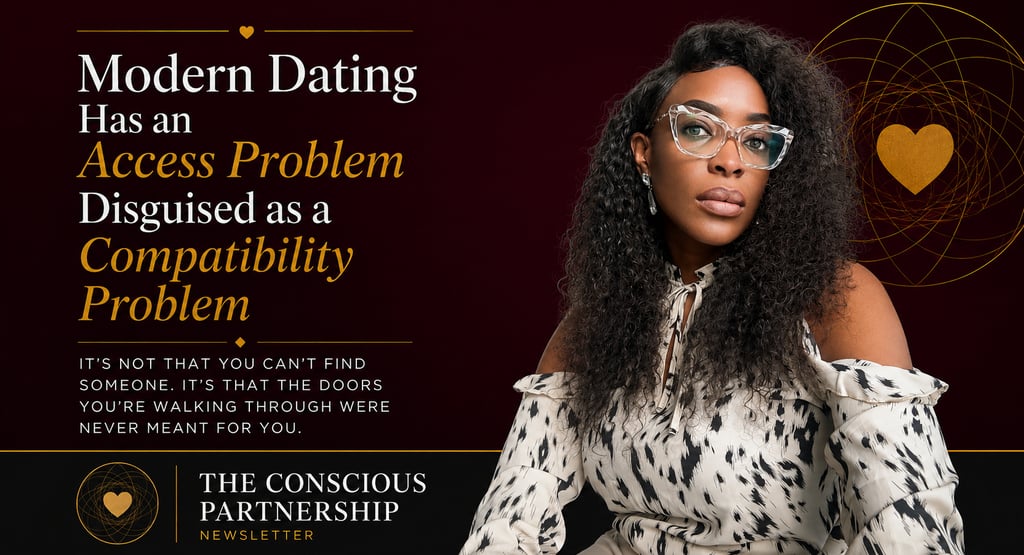
Modern Dating Has an Access Problem Disguised as a Compatibility Problem
The dating industry has largely been built around helping people find each other. Location, preferences, photos, prompts, interests, lifestyle markers, education, values, family goals. These data points matter.
Joan Nwosu
7/1/20264 min read
Why good connections still become confusing relationships
Many connections begin with real chemistry. The pull is there, the conversation flows, the possibility feels alive. But a relationship is not sustained by attraction alone.
It also needs functional compatibility, emotional rhythm, decision-making awareness, aligned pacing, and the capacity for growth. It needs a deeper sense of whether two people are moving toward something that can actually hold them.
Without that structure, people confuse intensity for intimacy. Familiarity becomes mistaken for safety. Chemistry gets conflated with compatibility. Shared interests get treated as shared direction. And by the time the pattern becomes clear, significant emotional investment has already been made.
That is the cost of choosing without discernment.
This is why I built LACE™
I spent years watching brilliant, self-aware women repeat the same relationship in different bodies. Women who had done the therapy, the retreats, the personal development. Who knew better and still chose from chemistry instead of alignment. The pattern was not a character flaw. It was a structural gap. They had access to more people than ever and no rigorous framework for understanding what they were actually choosing.
LACE™, the Love Alignment and Compatibility Engine, was built to close that gap.
LACE™ analyzes connection through three core dimensions. Chemistry reveals the energetic spark and quality of the initial pull. Compatibility reveals the functional fit, including how two people communicate, decide, and move through life together. Conscious Alignment reveals the long-term architecture, including whether two lives are pointed in compatible directions and whether the connection has the capacity to support growth over time.
Together, these layers produce a clearer picture of relationship potential. A structured way to understand what attraction alone cannot reveal.
Personal responsibility, communication, and emotional maturity remain the foundation. LACE™ adds the intelligence layer above them.
Discernment is the next evolution
The future of conscious dating cannot simply be more profiles, more prompts, more subscriptions, and more conversations that lead nowhere. People are asking for clarity. They need language for what they are experiencing. They need structure. They need a way to understand the connection beneath the performance, the preferences, and the initial spark.
A spark is not a strategy. A good conversation is not a foundation. A shared preference is not shared direction.
The deeper question is not whether two people match. It is whether they are aligned.
Joan
Love, by design.
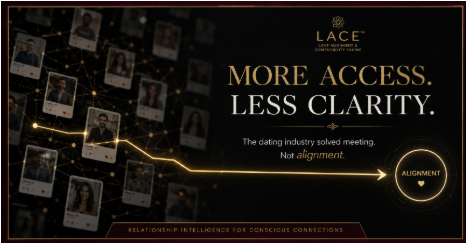
There are more ways to meet people than ever before. Dating apps, matchmaking companies, coaching programs, singles events, curated communities, AI-powered tools. The infrastructure exists at a scale previous generations could not have imagined.
And yet, despite all of this access, many people are still confused, exhausted, and genuinely unsure whether the connections they are forming have real relationship potential.
More access has not produced more clarity.
The dating industry has largely been built around helping people find each other. Location, preferences, photos, prompts, interests, lifestyle markers, education, values, family goals. These data points matter. They create a useful first filter, an initial pass at identifying whether someone belongs in a broad category of possibility.
But they do not tell the whole story. They do not reveal how two people make decisions together, how emotional energy moves between them, or whether one person's growth activates the other person's insecurity. They cannot show whether a relationship has the functional fit to support daily life, or whether two people are pointed in compatible directions over time.
Preference matching tells you whether someone fits your stated criteria. It does not tell you whether the connection has architecture.
More options can feel like freedom. Until it doesn't.
After a while, volume without deeper intelligence becomes noise. More swiping, more conversations, more comparisons, and still the same struggle to understand what is actually being chosen.
Attraction is easy to feel. Relationship potential is harder to read. Chemistry can arrive in minutes. Alignment reveals itself through patterns. Most dating platforms are still better at creating introductions than at interpreting what those introductions actually mean.
This is why so many people who are doing everything right still end up in the same place. Not because they are broken. Because the tools they have been given were never designed to answer the questions they are actually asking.
Why does this keep happening? Why do I keep choosing the same pattern in a different person? Why did it feel so strong at the start and still fall apart?
Those are not access questions. They are discernment questions.
Preference matching is a starting point, not a destination
Preference matching asks whether two people like the same things, want similar outcomes, and fit each other's stated criteria. That is a useful beginning.
Relationship intelligence asks deeper questions. How do your designs interact? How do you communicate under pressure? How do you make decisions? How do you move through conflict? How do you recognize love? Do your patterns reinforce or challenge each other? Do your lives point in directions that can grow together?
A strong connection on paper can still produce constant friction in real life. Two people can want the same outcome and still be incompatible in how they get there. Chemistry can feel powerful and still fail to become partnership. These are not failures of character. They are failures of insufficient information.
JOAN NWOSU
Pioneer of Relationship Intelligence. Author. Creator of LACE™
2026 Joan Nwosu. All rights reserved.