
The Algorithm Said We Were Perfect
When Compatibility Scores Miss the Most Important Thing
Joan Nwosu
4/15/20269 min read
Emma swiped right.
90% match. Shared values: check. Similar life goals: check. Both wanted kids, preferred city life, loved travel, valued personal growth.
The app said they were perfect.
Six months later, living together, Emma had never felt so alone.
The Perfect Match (On Paper)
Emma met Jordan on an app that promised "deep compatibility through advanced algorithms."
Their first message exchange went on for hours. He was thoughtful, curious, asked real questions. Their second date lasted until 2 a.m. Art galleries, dinner, walking through the city talking about everything.
"I've never connected with someone like this," Emma told her best friend Maya.
"What does he do?" Maya asked.
"He's a social impact consultant. Works with nonprofits on systemic change. He's... he cares about the world, you know? Like, really cares."
Maya smiled. "You found your person."
Emma thought so too.
Moving In Together
Three months in, Jordan asked Emma to move into his loft.
It made sense. They were always together. Emma's studio lease was ending. Jordan's place had space for her art supplies.
"We can build a life together," he said. "Consciously. Intentionally."
Emma loved that he used words like "intentionally." She loved that he thought about systems, about impact, about making the world better.
She said yes.
The first month was good. They cooked together, hosted dinner parties with Jordan's nonprofit friends, talked about the future.
But slowly, something started to feel... off.
The Invisible Distance
It started small.
Emma would come home from a hard day at work, her design client had rejected her third round of concepts, and she wanted to collapse on the couch with Jordan. Be held. Be told it would be okay.
Jordan would greet her warmly, ask about her day, then pivot: "You know, I was reading about how the design industry perpetuates inequality through"
"Can we not?" Emma interrupted. "I just need a hug right now."
"Of course," Jordan said, hugging her. But it felt perfunctory. Like he was checking a box.
Or:
Emma planned a surprise date night. Reservations at the restaurant where they had their second date. She dressed up, lit candles, wanting to reconnect.
Jordan appreciated it. He really did. But halfway through dinner, he started talking about a documentary he'd watched about food systems and how their meal was complicit in—
"Jordan," Emma said gently. "Can we just... be here? Together? Just us?"
He looked confused. "We are together. I'm sharing something important with you."
"I know. But I meant... just you and me. Not you and me and the world's problems."
"The world's problems are always here, Em. I can't just turn that off."
The Fight That Named It
It came to a head on a Saturday morning.
Emma woke up wanting to stay in bed, make love, be lazy together. She reached for Jordan.
He kissed her forehead. "Morning. I'm going to that climate march downtown. Want to come?"
"I was hoping we could have a slow morning. Together."
"We can do that after. It's important."
"I'm important too," Emma said quietly.
Jordan stopped. "What does that mean?"
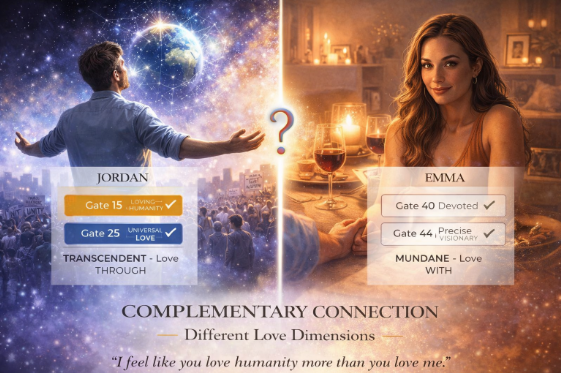
"It means... I feel like you love humanity more than you love me."
"That's not fair."
"Isn't it? When was the last time you chose me over a cause? When was the last time you looked at me—just me—without thinking about how I fit into the bigger picture?"
Jordan sat back down. "I don't know how to separate the two. Loving you IS part of loving the world. You're part of …"
"I don't want to be part of anything right now!" Emma's voice cracked. "I want to be THE thing. Just for one morning. Can you love me without it being about something bigger?"
The silence was devastating.
"I don't think I can," Jordan said finally. "That's not how I'm wired."
The Tool
Maya came over that night. Found Emma crying on the couch.
"Tell me what happened."
Emma explained. The loneliness. The feeling of being loved as a concept, not a person. The way Jordan's love always flowed through her to something beyond.
Maya pulled out her phone. "I want to show you something."
She pulled up the Love Gates Connection Tool. Entered both their information.
The results appeared.
Emma's Love Gates:
Gate 40 (The Devoted Provider)
Gate 44 (The Precise Visionary)
Jordan's Love Gates:
Gate 15 (Loving Humanity)
Gate 25 (Universal Love)
The tool highlighted: COMPLEMENTARY CONNECTION
"One of you loves THROUGH someone (Transcendent). One loves WITH someone (Mundane). You're operating in completely different love dimensions."
Emma stared at the screen.
"What does that mean?"
Maya read aloud:
"TRANSCENDENT GATES (15, 25, 46, 10): These experience love THROUGH someone to connect with something greater. The person becomes a vessel for connecting to spirit, humanity, and life itself. The love isn't personal, it's transcendent."
That was Jordan exactly.
"MUNDANE GATES (40, 44, 58, 41, 28, 55): These seek love WITH someone—personal, intimate, romantic connection. The love is about YOU and THEM specifically. It demands emotional intimacy and personal devotion."
That was Emma.
"So he's not... he's not choosing the world over me?"
"No," Maya said gently. "He's loving you the only way he knows how. Through you. To connect with something bigger. It's his design."
"But I need to be loved FOR me. Not as a gateway to humanity."
"I know. That's your design."
The Conversation
Emma showed Jordan the tool that night.
"Look at this. Your gates. My gates. We're in completely different categories."
Jordan read carefully. His face changed.
"This... this explains everything."
"Yeah."
"I'm not trying to make you feel small, Em. I just—when I love you, I feel connected to everything. To the beauty of existence. To the miracle of consciousness. Loving you opens me up to loving all of it."
"And when I love you," Emma said, "I want you to see ME. Not me as a representative of humanity. Not me as a beautiful consciousness. Just... me. Emma. The woman sitting across from you."
"Can we do both?" Jordan asked.
"I don't know. Can you?"
The Experiment
They didn't break up.
But they made a deal.
Every week, Jordan would commit to one evening where he loved Emma with, not through.
No talk of systems, causes, humanity, the bigger picture. Just her. Just them.
It was harder for him than Emma expected.
That first "Mundane Monday" (as they started calling it), Jordan kept catching himself.
Emma would share a story about her work. He'd start to connect it to broader design theory, systemic inequality, cultural patterns—
Emma would put her hand on his. "Mundane Monday."
He'd stop. Refocus. "You're right. Sorry. Tell me more about what you felt when the client said that."
"I felt unseen. Like they didn't get what I was trying to create."
"That must have been frustrating."
"It was."
And Jordan would just... be there. With her. Not solving, not connecting to larger themes. Just present with her frustration.
It felt awkward. Unfamiliar. But also... sweet.
What The Tool Showed Them
The Love Gates Connection Tool didn't fix their relationship.
But it gave them language.
The tool revealed:
Emma has Mundane gates (40, 44) - loves WITH someone.
Jordan has Transcendent gates (15, 25) - loves THROUGH someone.
This created a Complementary Connection.
They were speaking fundamentally different love languages..
Neither was wrong—they were just designed differently
The tool also explained what was possible:
"Complementary connections require translation. The Transcendent partner needs to ground into daily intimacy. The Mundane partner needs to allow space for transcendent connection. This pairing works beautifully when both honor the difference."
Six Months Later
Emma and Jordan are still together.
But they've stopped trying to make each other wrong.
Jordan still loves humanity. He still goes to marches, talks about systems, sees Emma as part of the beautiful web of existence.
But on Mundane Mondays, he practices loving her specifically. Personally. Without the cosmic frame.
Emma still wants devotion, recognition, intimate partnership. She still needs to be seen as an individual, not a concept.
But she's learning to appreciate that when Jordan loves her, he's loving her with every ounce of transcendent reverence he possesses. It's not less love. It's just a different frequency.
"I used to think you didn't love me enough," Emma told him recently. "Now I understand you love me so much it spills over into everything."
"And I used to think you were too needy," Jordan admitted. "Now I understand you just want what your design needs, to be chosen specifically, personally, intimately."
They're learning to be bilingual.
What This Means For You
If you're reading this and thinking: "My partner loves everyone and everything equally. I feel like just another person in their orbit. I want to be THE person" you might be in a Complementary connection.
You have Mundane gates. They have Transcendent gates.
You're trying to love WITH them. They're trying to love THROUGH you.
The Transcendent Gates (Love THROUGH Someone):
Gate 25 - Universal Love: Loving spirit, divine timing, holding space for the sacred.
Gate 15 - Loving Humanity: Compassion for all rhythms, tolerance for diversity, flow with humanity.
Gate 46 - Loving the Body: Embodiment, serendipity, physical presence in the world.
Gate 10 - Loving Being Alive: Self-love through existence, authenticity, being fully present.
If your partner has these:
They're not emotionally unavailable. They're spiritually wired to love THROUGH you to connect with something greater.
When they love you, they feel connected to Source, to humanity, to the beauty of existence itself.
This isn't cold. It's cosmic.
But it won't feel like the personal, devoted, "you're my everything" love you might crave if you have Mundane gates.
The Mundane Gates (Love WITH Someone):
Gate 40 - Earning Love Through Dedication: Devoted provision, commitment, showing up.
Gate 44 - Successful Love: Recognition, vision, building something valuable together.
Gate 58 - Perfecting Love: Refinement, improvement, elevating the relationship.
Gate 41 - Dreams of Love: Fantasy, desire, longing for deep connection.
Gate 28 - Love and Purpose: Finding meaning through partnership.
Gate 55 - Emotional Depth: Emotional intimacy, feeling deeply together.
If you have these:
You want love WITH someone specific. You want to be chosen, seen, devoted to as an individual.
You want your partner to look at you and see YOU—not you as a representative of consciousness, not you as a gateway to the divine.
You want personal, intimate, "you're my priority" love.
And there's nothing wrong with that.
How To Use The Connection Tool For This
The Love Gates Connection Tool will show you:
Which category each person is in - Transcendent or Mundane
If you're in a Complementary connection - One Transcendent + One Mundane
What this means for your dynamic - You're speaking different love languages at the foundational level
What translation looks like - How to bridge the gap
For Dating: See The Language Barrier Early
If Emma had known she had Mundane gates and Jordan had Transcendent gates BEFORE moving in, she could have:
Understood the "loving humanity more than me" feeling wasn't rejection.
Set expectations about what she needed (Mundane Mondays from day one).
Chosen him with eyes open to the translation work required.
Or chosen someone with Mundane gates who naturally spoke her language.
The tool shows you the love language gap before you're drowning in it.
For Couples: Stop Making Each Other Wrong
If you're already together and one of you feels "not prioritized" while the other feels "misunderstood":
The tool shows you it's not personal—it's design.
You can see exactly which category each person is in.
You stop judging the Transcendent partner as "detached".
You stop judging the Mundane partner as "needy".
You work with the difference instead of against it.
What This Is NOT
This is not:
An excuse to never meet your partner's needs ("I'm Transcendent, I can't help it").
A reason to break up ("We're too different").
A hierarchy ("Transcendent is more evolved than Mundane").
Permission to be incompatible forever.
This is an invitation to translation.
Why This Matters
Because the most confusing relationships aren't the ones with obvious incompatibility.
They're the ones where everything looks perfect on paper but feels wrong in practice.
Where you share values, goals, interests, but you still feel alone.
Where they love you, you know they love you, but it doesn't feel like the kind of love you need.
Complementary connections can be beautiful.
But they require something most couples don't even know they need: conscious translation.
The Transcendent partner must learn to ground their cosmic love into daily, personal, tangible expressions.
The Mundane partner must learn to allow space for their partner's transcendent connection without taking it personally.
It's the hardest work.
And when it works, it's alchemy.
Emma and Jordan are learning.
The algorithm was right—they are compatible.
Just not in the way the algorithm measured.
Try The Connection Tool
See your love language category. See your partner's. Understand the gap. Learn to translate.
Visit HERE to access the Love Gates Connection Tool.
Select both love gates. Look at the connection type.
If it says Complementary Connection, you're in different love dimensions.
Now you can build the bridge.
Not to make each other the same.
But to speak both languages.
Share this with a partner who feels "spiritually bypassing" or "emotionally unavailable."
Share this with someone who feels "too needy" or "too personal" in their love.
Share this with anyone in a relationship that looks perfect but feels lonely.
The algorithm said they were perfect.
The tool showed them why it felt so hard.
Now they're learning to love across dimensions.
JOAN NWOSU
Pioneer of Relationship Intelligence. Author. Creator of LACE™
2026 Joan Nwosu. All rights reserved.