
The Quality of Your Decisions Will Never Exceed the Quality of Your Discernment
Joan Nwosu introduces the Discernment Principle and explains why clearer perception is the foundation of wiser decisions in relationships, leadership, and life.
DISCERNMENTRELATIONSHIP INTELLIGENCE
Joan Nwosu
7/24/20268 min read
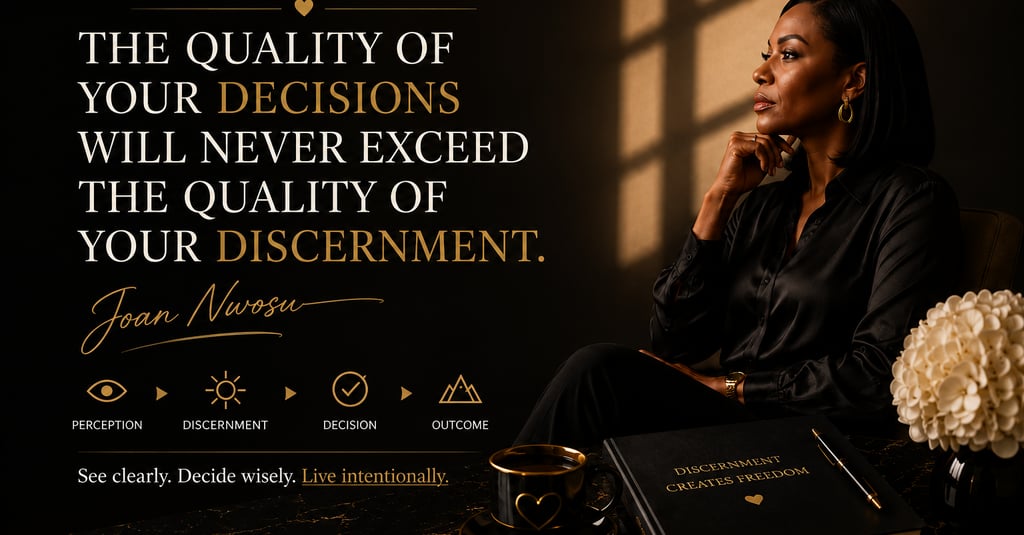

The Quality of Your Decisions Will Never Exceed the Quality of Your Discernment
Why better decisions begin long before you make them
There is a belief woven into almost every area of modern life:
If we could simply make better decisions, we would create better lives.
We read books about decision-making. We build frameworks to help us choose. We search for certainty before taking the next step.
But after years of studying relationships, observing human behaviour, building decision frameworks, and reflecting on my own life, I have come to believe that we often begin in the wrong place.
Better decisions are not the starting point.
Better discernment is.
Every decision begins long before the moment we choose. It begins with what we notice, how we interpret it, and whether we are willing to see reality clearly.
That is why I often say:
“The quality of your decisions will never exceed the quality of your discernment.”
I call this the Discernment Principle: the quality of a decision is constrained by the clarity of perception and discernment informing it.
This principle has become foundational to my work because it shifts our attention away from the decision alone and toward the awareness that produces it.
What Is Discernment?
Discernment is the disciplined practice of perceiving reality as clearly as possible before deciding how to respond.
It is not intuition alone.
It is not judgment alone.
It is not analysis alone.
It is the disciplined process of examining what we perceive before deciding what it means and how we should respond.
Discernment may include intuition, observation, judgment, evidence, experience, and analysis. But none of these is sufficient by itself.
Intuition may alert us to something.
Analysis may help us compare information.
Judgment may help us evaluate what we see.
Discernment brings these capacities together and asks whether our interpretation is grounded in reality or distorted by what we want, fear, assume, or have already invested.
At its centre is one deceptively simple question:
What is true here?
Not what do I hope is true.
Not what do I fear is true.
Not what would be convenient if it were true.
What is actually present?
Why Intelligent People Still Make Poor Decisions
Some of the brightest and most capable people make deeply misaligned decisions.
Not because they lack intelligence.
Intelligence does not automatically produce discernment.
Neither does education, experience, status, or professional success.
We have all seen intelligent people remain in relationships that repeatedly diminish them.
We have seen experienced leaders choose the wrong business partner.
We have watched capable people ignore obvious warning signs, remain loyal to opportunities that no longer fit, or confuse potential with evidence.
The problem is often not their ability to think.
It is their ability to perceive clearly while emotionally invested.
When perception becomes distorted, the quality of the decision usually declines with it.
Discernment Comes Before Decision
Most people imagine the process as:
Decision → Outcome
I see a longer sequence:
Perception → Discernment → Decision → Outcome
Each stage matters.
Perception is what we notice.
Discernment is how clearly we examine and interpret what we notice.
Decision is the response we choose.
Outcome is what follows, including factors outside our control.
We do not make decisions directly from reality. We make them from our interpretation of reality.
That distinction is critical.
Two people can encounter the same situation and reach completely different conclusions because they notice different things, assign different meanings to them, and filter the experience through different fears, desires, assumptions, and histories.
If our perception is incomplete, our discernment may be compromised.
If our discernment is compromised, even a carefully reasoned decision may move us further away from what is true.
Trying to improve decision-making without improving discernment is like adjusting the steering wheel while looking through a fogged windshield.
One of the Greatest Threats to Discernment
One of the greatest threats to discernment is emotional investment.
Hope can distort perception.
Fear can distort it.
Chemistry can distort it.
Loneliness can distort it.
Urgency can distort it.
Ambition can distort it.
Sunk costs can distort it.
The stories we have already told ourselves can distort it.
This does not mean emotion is the enemy of discernment. Emotion contains information. But emotion should not be allowed to rewrite reality.
The difficulty begins when we become so committed to a person, an opportunity, an identity, or a future we imagined that we stop examining what is actually happening.
The question is no longer:
What is true?
It becomes:
How can I make reality support the conclusion I have already chosen?
At that point, we are no longer discerning.
We are defending.
Discernment Is Not Certainty
Discernment is often confused with certainty.
They are not the same.
Certainty says:
I know exactly what will happen.
Discernment says:
Based on what is presently knowable, this is what appears most true and this is the wisest response available to me.
Discernment does not remove risk.
It does not predict every consequence.
It does not make us immune to change, disappointment, betrayal, or circumstances beyond our control.
It simply allows us to meet the decision with greater clarity and integrity.
That matters because many people delay necessary decisions while waiting for a level of certainty life rarely provides.
Discernment does not promise certainty.
It provides a more trustworthy basis for action.
Discernment Is Not About Being Right
Another misconception is that good discernment guarantees a desirable outcome.
It does not.
You can perceive reality carefully, make a wise decision, and still experience an outcome you did not want.
People change.
Markets shift.
Health declines.
Circumstances emerge that no one could reasonably have predicted.
Decisions influence outcomes, but they do not control them.
This is why discernment should not be judged only by what happened afterward.
It should also be judged by the quality of awareness available at the time of the decision.
Did you examine reality honestly?
Did you consider the evidence?
Did you notice what contradicted your preferred story?
Did you distinguish possibility from probability?
Did you give present reality more authority than past investment?
Did you respond from clarity rather than panic, fantasy, ego, or avoidance?
A sound decision can still produce an unexpected result.
An apparently successful outcome can also come from poor discernment, luck, or conditions that were never sustainable.
Outcomes matter, but they are not the only measure of wisdom.
The Difference Between Intuition and Discernment
Intuition is valuable.
It can register patterns before the conscious mind fully understands them. It can alert us to tension, possibility, danger, or recognition.
But intuition is not infallible.
Fear can sound intuitive.
Trauma can feel like instinct.
Familiarity can be mistaken for alignment.
Chemistry can be mistaken for compatibility.
Desire can be mistaken for divine confirmation.
Intuition may be the beginning of inquiry, but discernment requires examination.
It asks:
What am I sensing?
What evidence supports it?
What else could explain it?
Am I responding to the present or reliving the past?
Is this clarity, fear, projection, attachment, or wishful thinking?
Discernment does not silence intuition.
It gives intuition context.
The Hardest Person to Discern Is Often Yourself
It is usually easier to see another person’s pattern than your own.
We can recognize when a friend is rationalizing.
We can see when a colleague is ignoring evidence.
We can hear when someone is defending a decision they have already made emotionally.
But self-discernment is harder because we are both the observer and the person being observed.
Our identity is involved.
Our history is involved.
Our pride is involved.
Our longing is involved.
Our fear of being wrong is involved.
Sometimes what we are protecting is not the relationship, opportunity, or plan itself.
We are protecting our belief that we were right to choose it.
That is why discernment requires humility.
It asks us to become willing to revise our interpretation when reality presents new information.
Present Reality Must Outrank Past Investment
One of the clearest expressions of discernment is the willingness to give present reality more authority than past investment.
Time invested is not proof of continued alignment.
Money spent is not proof that an opportunity remains wise.
Love given is not proof that a relationship remains healthy.
Effort made is not proof that we must continue.
Past investment explains why something matters to us.
It does not determine whether it should continue.
Discernment asks us to evaluate what is true now, not only what was true when we began.
That can be painful because endings often require us to grieve not only what happened, but what we believed would happen.
Still, protecting an old decision at the expense of present reality does not honour the decision.
It simply compounds it.
Why This Matters in Relationships
Relationships are one of the places where discernment becomes most difficult and most necessary.
Attraction can be powerful.
Chemistry can feel convincing.
Potential can be intoxicating.
Hope can keep us invested long after the evidence has changed.
We may see who someone could become more clearly than who they are.
We may confuse intensity with intimacy.
We may interpret inconsistency as complexity.
We may call emotional activation destiny.
Discernment does not ask whether the connection feels meaningful.
It asks what the meaning of the connection actually is.
Some relationships are meant to be built.
Some are meant to teach.
Some reveal wounds.
Some reveal desires.
Some reveal who we become when we abandon ourselves.
Attraction tells us that something is happening.
Discernment helps us understand what is happening and whether it can support the life we are trying to build.
Why This Matters in Leadership and Business
Discernment is equally important in leadership.
Leaders make decisions about people, priorities, timing, partnerships, capital, risk, and direction.
The cost of poor discernment can be enormous.
A charismatic person may not be the right partner.
A compelling opportunity may not be strategically aligned.
A struggling initiative may need more patience, or it may need to end.
A loyal team member may still be in the wrong role.
A fast decision may look decisive while actually being reactive.
Good leadership requires more than confidence.
It requires the ability to see what is present without allowing ego, urgency, reputation, or sunk costs to dictate the conclusion.
The strongest leaders are not those who always know immediately.
They are those who know how to examine what they are seeing before they act.
Discernment Is an Act of Self-Respect
Discernment is not cold.
It is not cynical.
It is not the refusal to hope.
It is the refusal to abandon reality in order to preserve a preferred story.
That is an act of self-respect.
To discern is to say:
I will not make myself smaller to avoid seeing what is true.
I will not confuse my longing with evidence.
I will not allow past investment to make my present choices for me.
I will not demand certainty before I honour what I can already see.
I will listen to intuition, examine evidence, acknowledge emotion, and remain willing to revise my interpretation.
Discernment does not ask us to become detached from life.
It asks us to participate in life without surrendering our capacity to perceive it clearly.
A New Conversation About Discernment
I believe we spend far too much time teaching people how to make decisions and not nearly enough time helping them develop the discernment that makes wise decisions possible.
We ask:
What should I do?
Should I stay?
Should I leave?
Should I trust them?
Should I accept the opportunity?
Should I invest?
Should I begin again?
These questions matter.
But they are not always the first questions.
Before asking what to do, we may need to ask:
What am I actually seeing?
What meaning have I assigned to it?
What evidence supports that meaning?
What am I afraid to acknowledge?
What am I hoping will become true?
What would remain if I removed urgency, ego, fantasy, and fear?
That is the conversation I want to contribute to.
Not because discernment guarantees certainty.
Not because it protects us from every painful outcome.
But because it gives us a more honest place from which to choose.
And the place from which we choose matters.
Because the quality of our relationships, our leadership, our work, and our lives is shaped by the decisions we make.
And:
“The quality of your decisions will never exceed the quality of your discernment.” - Joan Nwosu
Written by Joan Nwosu
Published July 24, 2026
© 2026 Joan Nwosu
About Joan Nwosu
Joan Nwosu is an author, teacher of discernment, and Relationship Intelligence pioneer. Her work explores how the quality of our perception shapes the quality of our decisions, relationships, leadership, and lives. She is the founder of LACE™, the Love Alignment & Compatibility Engine, and the author of The New Love Languages.
JOAN NWOSU
Pioneer of Relationship Intelligence. Author. Creator of LACE™
2026 Joan Nwosu. All rights reserved.