
The Future of Dating Technology Is Relationship Intelligence
Dating technology's first great achievement was making people reachable. It opened the field beyond immediate social circles, workplaces, and neighborhoods. For people who were busy, newly single, or simply tired of waiting for chance, this was a genuine shift.
Joan Nwosu
7/22/20263 min read
Why the modern dater is ready for this
The modern dater is more self-aware than previous generations. They have language for attachment, emotional availability, nervous system patterns, and relational health. Many have done therapy, coaching, inner work, or serious personal development.
And still, many find themselves repeating the same relational patterns. That tells us something important. Awareness alone does not always create discernment. Knowing the language of healing does not always mean someone can interpret the architecture of a connection clearly while they are inside it.
Attraction can still cloud judgment. Chemistry can still be mistaken for compatibility. Potential can still be mistaken for alignment. Familiarity can still feel like safety.
People are not failing because they lack self-awareness. They are operating without the right tools.
What relationship intelligence actually does
Relationship intelligence does not tell people what to feel. It helps them understand what they are feeling. It does not replace chemistry. It helps people see whether chemistry has somewhere healthy to go. It does not make the choice. It supports the person making it.
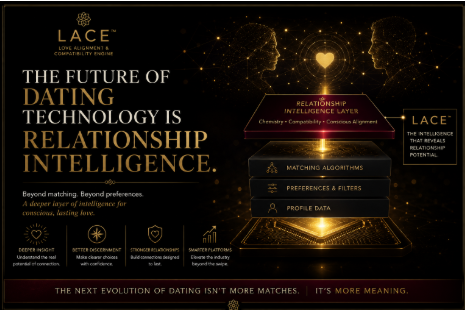
This is why LACE™, the Love Alignment and Compatibility Engine, was built as an intelligence layer rather than a matching tool. It analyzes connection through three core dimensions: Chemistry, which reveals the energetic spark and quality of the initial pull; Compatibility, which reveals the functional fit including communication, decision-making, and emotional rhythm; and Conscious Alignment, which reveals the long-term architecture and whether two lives are pointed in compatible directions.
Together these layers produce a structured relationship intelligence report. A clearer lens for understanding what attraction alone cannot reveal.
The question that defines the next era
The dating industry has already asked how to help people meet, then how to help people match. The next question is how to help people understand what they have found.
Matches are the beginning. Understanding is what comes next. And for the conscious dater who is done repeating the same pattern in a different person, that understanding is not a luxury. It is exactly what has been missing.
Joan
Love, by design.
People sometimes worry that bringing intelligence into love makes it less romantic. That structure removes mystery. That clarity kills the magic.
The framing I work from is different. Relationship intelligence removes unnecessary confusion. Mystery and clarity are not opposites. Wonder does not require blindness. Conscious love benefits from seeing what is actually there.
That distinction matters because the next era of dating technology is going to be built on exactly this. Not more access, not more optimization, but deeper understanding of what a connection actually is.
The first era was access
Dating technology's first great achievement was making people reachable. It opened the field beyond immediate social circles, workplaces, and neighborhoods. For people who were busy, newly single, or simply tired of waiting for chance, this was a genuine shift.
But access created a new problem alongside the possibility it opened. More profiles did not automatically produce more discernment. More conversations did not automatically produce more clarity. More options did not automatically produce better relationship outcomes.
The industry solved visibility. It did not solve interpretation.
The second era was preference matching
After access came optimization. Platforms began helping people filter by age, location, education, lifestyle, values, faith, family intentions, and personality traits. These features added real value. They helped narrow the field and created a sense of algorithmic relevance.
But preference matching still depends on what people say about themselves. People do not always know themselves clearly. They often describe the partner they think they should want rather than the relationship pattern they are actually available for. Someone may list values they admire but not yet embody. Someone may say they want emotional availability while still gravitating toward familiar forms of distance or intensity.
Preference matching can tell you what someone claims to want. It cannot reveal the deeper architecture of what two people create together.
The third era is relationship intelligence
The next evolution of dating technology must go beyond helping people find each other. It must help people understand the connection itself.
Relationship intelligence asks better questions. What is the energetic quality of the pull between these two people? Where is the functional compatibility? How do their decision-making styles interact? How does emotional energy move between them? Are their lives pointed in compatible directions? Does the connection have architecture beyond attraction?
This is not a replacement for chemistry, communication, or lived experience. It is a deeper interpretive layer. One that helps people understand what they are experiencing rather than simply intensifying their exposure to more of it.
JOAN NWOSU
Pioneer of Relationship Intelligence. Author. Creator of LACE™
2026 Joan Nwosu. All rights reserved.